2022年7月4日星期一

Heavy Duty CNC Turning Lathe CK6150E Exported To USA

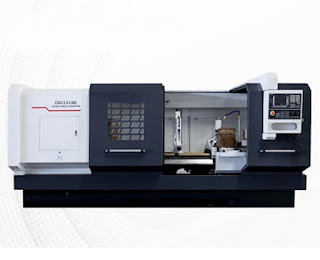
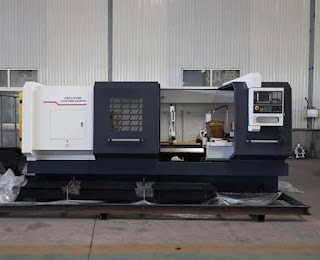
 Heavy Duty CNC Turning Lathe CK6150E designed and fabricated by HAISHU Machinery is a kind of widely used horizontal CNC lathe equipped with a powerful CNC system, a four-station electric turret, or a horizontal six-station turret.  Our CNC turning lathe CK6150E provides affordable flexibility for metal cutting, turning, or drilling functions. This kind of CNC lathe machine provides stability, rigidity, and accuracy for a variety of applications. We can also customize it to many different types acording to your requirements, including adding live tooling with C-axis, and Y-axis. So CNC lathe CK6150E can be customized as a multifunctional turning center.

The USA customer just told us that they needed a big size CNC lathes at the beginning and no other more information. We helped them get detailed data on their new workpiece. At the same time, our engineer confirmed a suitable model for him. So we sent the details of Heavy Duty CNC Turning Lathe CK6150E to him, and also sent him a processing video. They thought this model was much suitable and wanted to use a brand CNC system. According to his request, we sent the quotation. He was very satisfied and recognized our seriousness and professionalism very much. After he received the quotation he sent us the PO directly and arrange the deposit soon.

After the Heavy Duty CNC Turning Lathe CK6150E was completed, we processed the samples according to his parts and he was glad and paid the balance soon.

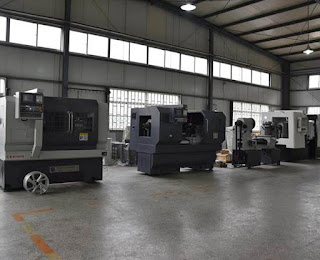
bed-lathe-CK6150E-Export-To-USA

cnc-lathe-CK6150E-Export-To-USA

cnc-lathe-machine-CK6150E-Export-To-USA

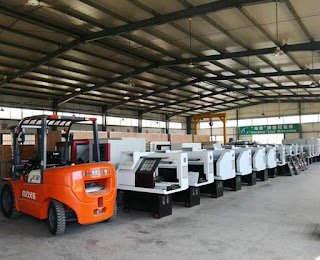
cnc-lathe-price-CK6150E-Export-To-USA

cnc-metal-lathe-CK6150E-Export-To-USA

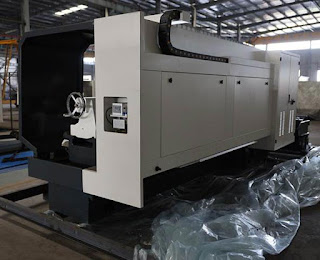
Heavy-Duty-CNC-Turning-Lathe-CK6150E-Export-To-USA

Heavy Duty CNC Turning Lathe CK6150E Main Technical Parameters

Maximum workpiece swing diameter over bedф500mm
Maximum workpiece swing diameter over slideф280mm
Maximum length of workpiece1000mm
Width of guide rails420mm
Two top allow to support the maximum workpiece weight1000kg
The height of the spindle center from the bed280mm
Spindle bore diameterф82mm
The form of spindle headC8
Taper of front end of spindle hole and taper of topMetric 90mm  1:20
Spindle speed series mechanical third gear100r/min / 300r/min / 885r/min
Range of spindle speeds (Frequency stepless speed regulation)50-1700r/min
Three-jaw chuckK71250    Three-jaw self-centering ф250mm
Main motor model and powerYVP132M-4    7.5Kw   1440r/min
X/Z direction minimum feed increment0.001/0.001 mm
X/Z feed range1~2000mm/min
X-direction ball screw diameter and pitchф25mm*5mm
Z-direction ball screw diameter and pitchф40mm*8mm
X-direction servo drive motor rated torque6N.m
Z-direction servo drive motor rated torque10N.m
The vertical distance from the spindle center line to the tool support surface28mm
Tool cross-section specifications25*25mm
Turret Number of toolVertical four-station
Repeated positioning accuracy of tool post indexing0.01 mm
Saddle max travel on lateral                 Z direction1000mm
Turret max travel on lateral  X direction300mm
Saddle rapid movement speed on lateral      Z direction8000mm/min
Turret rapid movement speed on lateral       X direction6000mm/min
Tailstock quill diameterφ75
Tailstock quill travel170
Tailstock quill taperMT5
The lathe Dimensions (L × W × H)2700*1600*1550
Lathe Net(CK6150EX1000)3000kg

About HAISHU Machinery

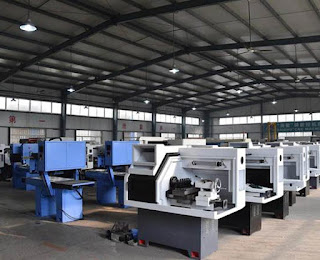
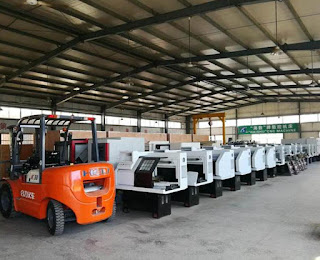
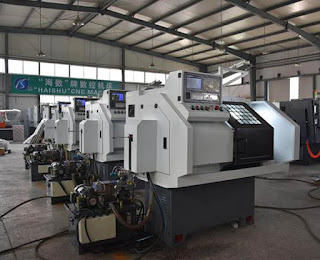
Taian HAISHU Machinery Co., Ltd (Haishu Machinery) is a high-tech enterprise specializing in CNC machine development, production, sales, and service since 2001. CNC lathes are used to change some of the disadvantages of current manual production lathes, such as low processing efficiency, large manpower requirements, and poor processing accuracy. The CNC lathe is controlled by the CNC system and programmed in a common language. And different workpiece needs to have different sizes, types, and functions, all of which contribute to the development of automation. As a professional CNC machine designer and manufacturer, We are committed to customizing solutions for customers. As long as you put forward your needs, we can design the most suitable CNC machine for you, such as Heavy Duty CNC Turning Lathe . Welcome contact


2022年6月21日星期二

The Basic Nine Operation Steps Of Common CNC Machine Tools

 CNC machine tools, I believe that everyone who has been in contact with the machinery industry knows that CNC machine tools can be more easily controlled by computers, which not only saves manpower but also greatly improves work efficiency. The following is the general operation process of CNC machine tools, let’s take a look!

  1. Editing and input of workpiece programs

Before processing, the machining process and processing program of the workpiece should be analyzed and compiled first. If the processing program of the workpiece is long or complicated, do not program on the CNC lathe but use a programming machine or computer to program, and then back it up through a floppy disk or communication interface. into the CNC system of the CNC lathe machine. This can avoid occupying machine time and increase the auxiliary time of processing.

  1. Boot

Generally, the main power is turned on first, so that the CNC machine tool has the starting conditions. Start a CNC system with a key button and the machine tool is powered on at the same time. The CRT of the CNC machine tool system displays information. Connection status of clam and other auxiliary equipment.

  1. Fixed reference point

Before machining the machine tool, establish the movement datum of each coordinate of the machine tool.

  1. Input call of the machining program

According to the program medium (tape, disk), it can be input by a tape machine, programming machine, or serial communication. If it is a simple program, it can be input directly on the CNC control panel by keyboard, or input segment by segment in MDI mode for remote segment processing. Before machining, the origin of the piece, tool parameters, offset, and various compensation values ​​must also be input into the Garding program.

  1. Program editing

If the program under the jurisdiction needs to be modified, the working mode selection switch should be placed in the editing position. Use the edit key to add, delete, and change.

  1. Program inspection and debugging

First, lock the machine and run the system only. This step is to check the program. If there is any error, it needs to be edited again.

  1. Workpiece installation and alignment

Install and align the next part to be processed and establish a benchmark. The method adopts manual incremental movement, continuous movement, or manual wheel movement of the machine tool. Set the starting point to the beginning of the program, and set the reference of the tool.

  1. Start the axes for continuous machining

Continuous processing generally uses program processing in memory. The feed rate in CNC machine tool processing can be adjusted by the feed rate switch. During processing, you can press the feed hold button to pause the feed movement to observe the processing situation or perform the manual measurements. Press the cycle start button again to resume processing. In order to ensure that the bowl is correct, it should be re-checked before processing. During milling, for plane curved workpieces, a pencil can be used instead of a tool to draw the outline of the workpiece on the paper, which is more intuitive. If the system has a tool path, the simulation function can be used to check the correctness of the program.

  1. shutdown

After processing and before turning off the power, pay attention to checking the status of the CNC machine tool and the position of each part of the machine tool. Turn off the machine power first, then turn off the system power, and finally turn off the main power.

The Basic Nine Operation Steps Of Common CNC lathe Machine

The Basic Nine Operation Steps Of Common cnc lathe

The Basic Nine Operation Steps Of Common CNC Machine Tools

The Basic Nine Operation Steps Of Commonmet metal cnc lathe

2022年3月20日星期日

Advantages Of CNC Lathes

 dvantages Of CNC Lathes

Programmable logic controller (Programmable Logical Controller, PLC for short) is the important part of CNC lathes, it is also a general-purpose automatic control device based on the processor, which is used to complete various logic operations and sequence control of CNC machine tools, such as machine tool start and stop, workpiece Auxiliary actions such as clamping, tool change, coolant switch, etc. PLC also accepts the instructions of the machine tool operation panel. On the one hand, it directly controls the action of the machine tool; The PLC in the CNC lathe machine has a built-in type and independent type.

The operation of the numerical control machine tool is realized through the man-machine operation panel, which is composed of the numerical control panel and the machine tool panel.

The CNC panel is the operation panel of the CNC system, which consists of a display and a manual data input (Manual Data Input, MDI) keyboard, also known as the MD panel. The lower part of the display is often provided with a menu selection key for menu selection. In addition to various symbols, numbers and functions, the keyboard can also be set up! User-defined health is also can be checked automatically . The operator can realize system management through the keyboard and display, input, store, edit and modify the numerical control program and related data. During processing, the screen can dynamically display system status and fault diagnosis report. In addition, the numerical control program and data can also be imported through the disk or the communication interface box.

The machine tool operation panel is mainly used for the operation of the machine tool in the manual mode, and the operation or preview of the machine tool in the automatic mode. There are various buttons and selection switches on it, which are used for starting and stopping of machine tools and auxiliary equipment, selection of processing methods, selection of speed magnification, etc. There are also digital tubes and signal displays. The operation panel of medium and small CNC machine tools is often integrated with the CNC panel, but there is a clear boundary between the two. The communication interface of the numerical control system, such as the serial interface, is permanent and on the machine tool operation panel.

Advantages of CNC Lathes machine

Advantages of CNC Lathes

cnc lathe price

cnc milling machine center

Development trend

Since entering the 21st century, with the continuous development of CNC technology and the expansion of application fields, it has played an increasingly important role in the development of some important industries (IT, automobile, light industry, medical care, etc.) for the national economy and people’s livelihood. The digitization of required equipment is a major trend in modern development. In general, CNC lathes show the following three development trends.

High speed and high precision

High speed and precision are the eternal goals of machine tool development. With the rapid development of science and technology, the speed of replacement of electromechanical products is accelerated, and the requirements for the precision and surface quality of parts processing are also higher and higher. In order to meet the needs of this complex and changeable market, the current machine tools are developing in the direction of high-speed cutting, dry cutting, and quasi-dry cutting, and the machining accuracy is constantly improving. On the other hand, the successful application of electric spindles and linear motors, ceramic ball bearings, high-precision large-lead hollow internal cooling and ball nut strong cooling low-temperature high-speed ball screw pairs and linear guide pairs with ball cages and other machine tool functional components The launch of the machine tool has also created conditions for the development of high-speed and precision machine tools.

The CNC lathe adopts an electric spindle, which cancels the links such as belts, pulleys, and gears greatly reduce the rotational inertia of the main drive, improves the dynamic response speed and working accuracy of the spindle, and completely solves the problem of belts and pulleys when the spindle runs at high speed. Vibration and noise issues. The use of an electric spindle structure can make the spindle speed reach more than 10000r/min.

The linear motor has high drive speed, good acceleration, and deceleration characteristics, and has excellent response characteristics and following accuracy. The use of linear motor as servo drive eliminates the intermediate transmission link of the ball screw, eliminates the transmission gap (including backlash), the motion inertia is small, the system rigidity is good, and it can be precisely positioned at high speed, thus greatly improving the Servo accuracy.

Because of its zero clearance in all directions and very small rolling friction, the linear rolling guide pair has small wear and negligible heat generation and has very good thermal stability, which improves the positioning accuracy and repeatability of the whole process. Through the application of linear motor and linear rolling guide pair, the rapid moving speed of the machine tool can be increased from 10-20m/min to 60-80m/min, and the highest is 120m/min.

High reliability

The reliability of CNC machine tools is a key indicator of the quality of CNC machine tools. Whether the CNC machine tool can exert its high performance, high precision, and high efficiency, and obtain good benefits, the key depends on its reliability.

CNC lathe design, Structural design and Optimization

With the popularization of computer applications and the development of software technology, CAD technology has been widely developed. CAD can not only replace the tedious drawing work with manual work, but more importantly, it can carry out design scheme selection and static and dynamic characteristic analysis, calculation, prediction, and optimization design of the large-scale whole machine, and can carry out dynamic simulation of each working part of the whole machine. . On the basis of modularity, the three-dimensional geometric model and realistic color of the product can be seen in the design stage. The use of CAD can also greatly improve work efficiency and improve the one-time success rate of design, thereby shortening the trial production cycle, reducing design costs, and improving market competitiveness.


2022年3月2日星期三

CNC Pipe Threading Lathes CKG1319B

 CNC Pipe Threading Lathes CKG1319B is widely used for pipe threading work which is mainly designed not only for the threading of pipework in the petroleum industry but also for the turning of pipe threads of various kinds like cylindrical and conical threads and end-face threads as well. HAISHU brand CNC pipe threading machine is also capable of performing the tightest threading functions on big pipes with independent spindle, servo drives, excellent precision, and variable speed. CNC Pipe Threading Lathes machine is equipped with an overall casting bed, 750mm rail width, two gears mechanical transmission, frequency step-less speed regulator which features good flexibility, high efficiency, heavyweight, good rigidity and stability, easy to program, and simple to operate.

Our Russia customer needed a CNC pipe threading machine. According to the workpiece diameter, we chose CNC Lathe CKG1319B for him. After checking the parameter of the CNC Pipe Threading Machine CKG1319B, Then the customer wanted to customize the configuration with the brand he requested, and sent us all the configuration lists. Our engineer confirmed we can meet his request. Then we provided the detailed quotation of the CNC lathe machine for him. He also requested the full protection of CNC Pipe Lathe CKG1319B. He was satisfied. A few days later, he asked for the invoice and arranged the payment.

After the CNC Pipe Threading Lathes CKG1319B was completed, We invited him to accept the test. He said that he didn’t have time and was very comfortable with our machines. So we sent him the CNC Pipe Threading Machine CKG1319B operate video and the completed workpieces. He was very happy to cooperate with us.

Max dia. swing over bedΦ630mm
Max dia. swing over cross slideΦ340mm
Max length of work-piece1500mm
Width of bed550mm Overall floor-standing
Spindle bore diameterΦ200mm
Power of spindle motor11kw
Mode of spindle speedTwo gears. smooth adjustment
Range of spindle speedL:25-120 ,H:100-500
Max travel of X/Z350/1250mm
X/Z rapid traverse4000mm/min
X axis motor speed1500r/min
X axis motor torque10N.m
X axis motor power1.5kw
Z axis motor speed1500r/min
Z axis motor torque15N.m
Z axis motor power2.3kw
Tailstock quill diameter100mm
Tailstock quill taperMT5
Tailstock quill travel250 mm
Turret modelHAK-21240
Turret typeVertical 4 station
Turret size240*240mm
Turret indexing time2.6s
ChuckK11-500 3-Jaw chuck
positioning accuracy0.02mm
Repeat positioning accuracy0.01mm
Machine size3700*1600*1800mm
Weight(kg)5200kg

cnc lathe CKG1319B Export To Russia

cnc lathe machine CKG1319B Export To Russia

CNC Pipe Threading Lathes CKG1319B Export To Russia

cnc turning lathe CKG1319B Export To Russia

cnc turning lathe CKG1319B Export To Russia

cnc turning lathe CKG1319B Export To Russia

CNC Pipe Threading Lathes CKG1319B Standard configuration:

  1. CNC system: GSK980TC3
  2. Servo spindle
  3. The double-manual three-jaw chuck
  4. Four-station electric turret
  5. Manual tailstock
  6. Automatic lubrication system
  7. Turning cooling system
  8. Power supply: 380V/50HZ

CNC Pipe Threading Lathes CKG1319B Optional configuration

CNC system – KND, SIEMENS, FANUC

Chuck: Electric, pneumatic, hydraulic

Horizontal six-position electric turret

The rear bracket

CNC Pipe Threading Lathes CKG1319B Features

Independent spindle, servo drives, variable speed

Good flexibility

High efficiency

Finishing up with good conformity

Easy to program

Easy to operate and maintain

About HAISHU Machinery

As a professional CNC machine designer and manufacturer, Taian Haishu Machinery Co., Ltd (Haishu Machinery) is a high-tech enterprise specialized in CNC machine development, production, sales, and service since 2001. We have more than 30 professional talented CNC experts and more than 12,000 square meters manufacturing factories.  More than 16 series 80 kinds of CNC machines and related parts had been manufactured to satisfy your pumping requirements. Our high quality and innovative products include Flat Bed CNC Lathe, CNC milling machine, CNC machining center, Slant Bed CNC Lathe Machine, CNC tool grinding machine, CNC Pipe Threading Lathes, CNC wood lathe, stone CNC machine, CNC root canal file grinder, and custom CNC equipment for special requirements.

HAISHU Machinery is not only manufacturing the best quality CNC Pipe Threading Lathes but also providing custom product design, fabrication, and after-sale services. Welcome, contact us for detailed information.


2022年1月14日星期五

Chucker CNC Lathe Maintenance And Programming

 Chucker CNC Lathe is an automatic machine tool with high precision and high efficiency. Equipped with a multi-station turret or power turret, the machine tool has a wide range of processing performance. CNC turning machines can process linear cylinders, oblique cylinders, circular arcs, various threads, grooves, worms, and other complex workpieces. CNC lathe machine has various compensation functions of linear interpolation and circular arc interpolation and has played a good economic effect in the mass production of complex parts. The maintenance of the NC lathe with the inclined bed is analyzed as follows:

In order to ensure the working accuracy and prolong the service life of the inclined bed NC lathe, it is necessary to carry out reasonable maintenance for the self-use inclined bed NC lathe. The quality of lathe maintenance directly affects the machining quality and production efficiency of workpieces. When the Taiwan Taiyu precision Chucker CNC lathe runs for 500h, it needs first-class maintenance. The maintenance of the inclined bed Chucker CNC lathe is mainly carried out by operators and coordinated by maintenance workers. During maintenance, the electric probe must be cut off first, and then the maintenance shall be carried out according to the maintenance contents and requirements.

Chucker CNC Lathe Maintenance And Code

cnc lathe machine Maintenance And Code

cnc turning machine Maintenance And Code

cnc turning machine Maintenance And Code

NC Programming

Chucker CNC lathe preparation function g code (jb3208-83). G code (or G instruction) is a process instruction that needs to be specified in advance before interpolation operation of NC machine tool system to prepare for interpolation operation, such as selection of coordinate plane, designation of interpolation mode, designation of fixed cycle functions such as hole machining, etc. G code is composed of address g followed by two digits. G00 ~ G99 are commonly used. Some modern CNC machine tool systems have been extended to three digits. G codes are divided into modal codes and nonmodal codes according to functional categories. a. C, D,… J, K, and other 9 groups. The G code corresponding to the same group is called modal code, which means that once a G code in the group (such as G17 in group C) is specified, the function will remain valid until any other code in the same group (such as G18 or G19) appears, otherwise it will remain valid. Therefore, when compiling the next program segment, if the same G code needs to be used, it can be omitted, which can simplify the processing programming. The nonmodal code is only valid in this section.

Note: 1. G codes indicated by lowercase letters a, B, C, D,… Are the same group of codes, which are called modal instructions;

  1. “#” represents that if it is selected for a special purpose, mini CNC lathe must be described in the program format description;
  2. The letter (d) in the brackets in the second column can be canceled or replaced by the letter (d) without brackets in the same column, or by the letter (d) with brackets;
  3. “Do not specify” and “never specify” codes respectively indicate that new functions and never specify functions can be specified when the standard is revised in the future;

When the CNC system does not have g53 to G59 and g63 functions, it can be designated for other purposes.


2021年4月12日星期一

What Is CNC Metal Lathe Machine

 CNC Metal lathe machine or metalworking lathe machine is a large category of CNC lathes designed for precisely machining relatively hard materials. They were originally designed to process metals; however, with the advent of plastics and other materials, and with their inherent versatility, they can also be used in a wide range of applications, and a broad range of materials. In machining jargon, where the larger context is already understood, they are usually simply called lathes, or else referred to by more-specific subtype names (toolroom lathe, turret lathe, etc.). These rigid machine tools remove material from a rotating workpiece via the (typically linear) movements of various cutting tools, such as tool bits and drill bits.

What is metal lathe machineWhat is metal lathe machine

what is cnc lathe price

What is CNC Lathe

What is cnc lathe machine

CNC Metal lathe Machine / CNC turning center

Computer numerical controlled (CNC) lathes are rapidly replacing the older production lathes (such as multispindle, etc.)  due to their ease of setting, operation, repeatability, and accuracy. A CNC Turning Lathe is a computer-Controlled piece of machinery. It allows basic machining operations such as turning and drilling to be carried out as on a conventional lathe. They are designed to use modern carbide tooling and fully use modern processes. The part may be designed and the tool paths programmed by the CAD/CAM process or manually by the programmer, and the resulting file uploaded to the machine, and once set and trialed the machine will continue to turn out parts under the occasional supervision of an operator.

The CNC Metal lathe machine is controlled electronically via a computer menu style interface, the program may be modified and displayed at the machine, along with a simulated view of the process. The setter/operator needs a high level of skill to perform the process. However, the knowledge base is broader compared to the older production machines where intimate knowledge of each machine was considered essential. These machines are often set and operated by the same person, where the operator will supervise a small number of machines (cell).

The design of a metal lathe machine varies with different manufacturers, but they all have some common elements. The turret holds the tool holders and indexes them as needed, the spindle holds the workpiece and there are slides that let the turret move in multiple axes simultaneously. The machines are often totally enclosed, due in large part to occupational health and safety (OH&S) issues.

With the rapid growth in this industry, different CNC lathe manufacturers use different user interfaces which sometimes makes it difficult for operators as they have to be acquainted with them. With the advent of cheap computers, free operating systems such as Linux, and open-source CNC software, the entry price of CNC machines has plummeted.

CNC Horizontal Milling

CNC horizontal machining is performed using horizontally-configured metal lathe machines, machining centers, boring machines, or boring mills. The equipment used typically consists of rotating cylindrical cutters moving up and down along five axes. These machines are capable of producing a variety of shapes, slots, holes, and details on a three-dimensional part.

CNC Vertical Milling

Vertically-oriented CNC machines utilize cylindrical cutters on a vertical spindle axis to create plunge cuts and drilled holes, as well as custom shapes, slots, and details on three-dimensional parts. Equipment used in this type of milling includes vertical lathes, vertical machining centers, and 5-axis machines.[7]

Swiss-style lathe / Swiss turning center 

A view inside the enclosure of a CNC Swiss-style lathe/screw machine

A Swiss-style lathe is a specific design of lathe providing extreme accuracy (sometimes holding tolerances as small as a few tenths of a thousandth of an inch—a few micrometers). A Swiss-style lathe holds the workpiece with both a collet and a guide bushing. The collet sits behind the guide bushing, and the tools sit in front of the guide bushing, holding stationary on the Z axis. To cut lengthwise along the part, the tools will move in and the material itself will move back and forth along the Z axis. This allows all the work to be done on the material near the guide bushing where it is more rigid, making them ideal for working on slender workpieces as the part is held firmly with little chance of deflection or vibration occurring. This style of lathe is commonly used under CNC control.

Most CNC Swiss-style lathes today use one or two main spindles plus one or two back spindles (secondary spindles). The main spindle is used with the guide bushing for the main machining operations. The secondary spindle is located behind the part, aligned on the Z axis. In simple operation it picks up the part as it is cut off, and accepts it for second operations, then ejects it into a bin, eliminating the need to have an operator manually change each part, as is often the case with standard CNC turning centers. This makes them very efficient, as these machines are capable of fast cycle times, producing simple parts in one cycle (i.e., no need for a second machine to finish the part with second operations), in as little as 10–15 seconds. This makes them ideal for large production runs of small-diameter parts.

Swiss-style Lathes and Live Tooling

As many Swiss lathes incorporate a secondary spindle, or ‘sub-spindle’, they also incorporate ‘live tooling‘. Live tools are rotary cutting tools that are powered by a small motor independently of the spindle motor(s). Live tools increase the intricacy of components that can be manufactured by the Swiss lathe. For instance, automatically producing a part with a hole drilled perpendicular to the main axis (the axis of rotation of the spindles) is very economical with live tooling, and similarly uneconomical if done as a secondary operation after machining by the metal lathe machine is complete. A ‘secondary operation’ is a machining operation requiring a partially completed part to be secured in a second machine to complete the manufacturing process. Generally, advanced CAD/CAM software uses live tools in addition to the main spindles so that most parts that can be drawn by a CAD system can actually be manufactured by the machines that the CAD/CAM software support.

Combination lathe / 3-in-1 machine

A combination lathe, often known as a 3-in-1 machine, introduces drilling or milling operations into the design of the lathe. These machines have a milling column rising up above the lathe bed, and they utilize the carriage and topslide as the X and Y axes for the milling column. The 3-in-1 name comes from the idea of having a lathe, milling machine, and drill press all in one affordable machine tool. These are exclusive to the hobbyist and MRO markets, as they inevitably involve compromises in size, features, rigidity, and precision in order to remain affordable. Nevertheless, they meet the demand of their niche quite well, and are capable of high accuracy given enough time and skill. They may be found in smaller, non-machine-oriented businesses where the occasional small part must be machined, especially where the exacting tolerances of expensive toolroom machines, besides being unaffordable, would be overkill for the application from an engineering perspective.

CNC Metal Lathe Machine, Mini-lathe and micro-lathe

CNC metal lathe machine ,Mini-lathes and micro-lathes are miniature versions of a general-purpose center lathe (engine lathe). They typically only handle work of 3 to 7 in (76 to 178 mm) diameter (in other words, 1.5 to 3.5 in (38 to 89 mm) radius). They are small and affordable lathes for the home workshop or MRO shop. The same advantages and disadvantages apply to these machines as explained earlier regarding 3-in-1 machines.

As found elsewhere in English-language orthography, there is variation in the styling of the prefixes in these machines’ names. They are alternately styled as mini-lathe, mini-lathe, and mini-lathe and as micro lathe, micro lathe, and micro-lathe.

Brake lathe

A lathe specialized for the task of resurfacing brake drums and discs in automotive or truck garages.

Wheel lathe

Wheel lathes are machines used to manufacture and resurface the wheels of railway cars. When wheels become worn or compromised from excessive use, this tool can be used to re-cut and recondition the wheel of the train car. There are a number of different wheel lathes available including underfloor variations for resurfacing wheels that are still attached to the rail car, portable types that are easily transported for emergency wheel repairs, and CNC versions that utilize computer-based operating systems to complete the wheel repair.

Pit lathe

A lathe for large diameter, though short work, built over a recess in the floor to admit the lower part of the workpiece thus allowing the coolest to stand at the turner’s waist height. An example is on display at the London Science Museum, Kensington.

Vertical lathe

For even larger diameter and heavier work, such as pressure vessels or marine engines, the lathe is rotated so it takes the form of a turntable on which parts are placed. This orientation is less convenient for the operator but makes it easier to support large parts. In the largest, the turntable is installed flush with the floor, with the headstock recessed below, to facilitate loading and unloading workpieces.

Because operator access is less of an issue for them, CNC vertical turning machines are more popular than manual vertical lathes.

Oil country lathe

Specialized lathes for machining long workpieces such as segments of drill strings. Oil country lathes are equipped with large-bore hollow spindles, a second chuck on the opposite side of the headstock, and frequently outboard steadies for supporting long workpieces.

Feed mechanisms

Various feed mechanisms exist to feed material into a lathe at a defined rate. The aim of these mechanisms is to automate part of the production process with the end goal of improving productivity.

Bar feeder

A bar feeder feeds a single piece of bar stock into the cutting machine. As each part is machined, the cutting tool creates a final cut to separate the part from the bar stock, and the feeder continues to feed the bar for the next part, allowing for continual operation of the machine. There are two types of bar feeds used in lathe machining: Hydrodynamic bar feeds, which rest the bar stock in a series of channels whilst clamping down on the top and bottom of the bar, and hydrostatic bar feeds, which hold the bar stock in a feed tube using pressurized oil.[9]

Bar loader

A bar loader is a variation on the bar feeder concept in that multiple pieces of bar stock may be fed into a hopper, and the loader feeds each piece as necessary.